
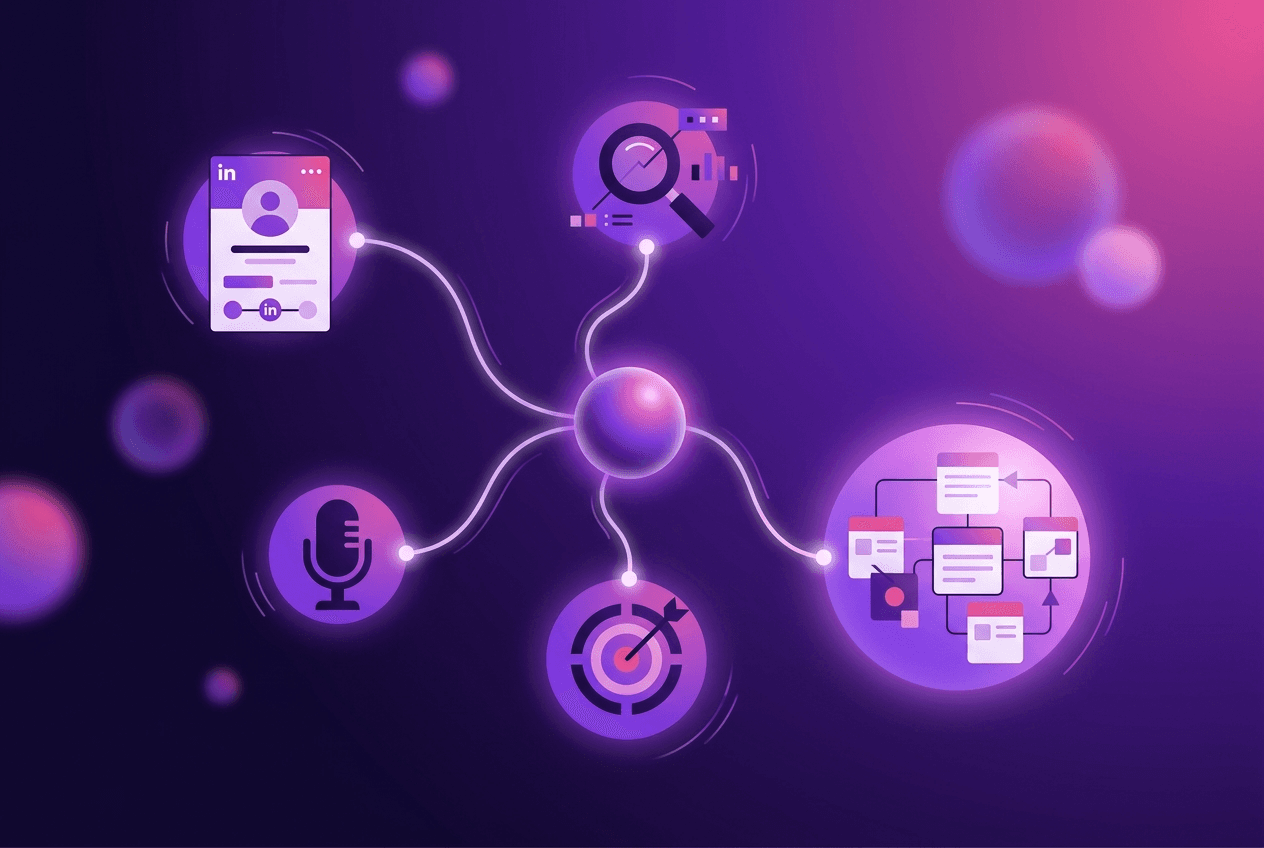
B2B paid acquisition has gotten expensive, auction-driven, and harder to attribute. Meanwhile, a lot of the most consistent B2B pipeline today comes from channels that don't touch a paid ad platform at all.
This is a practical playbook for generating B2B leads through organic channels.
The five organic B2B channels that work
Most B2B teams that run successfully without heavy paid spend combine a subset of these:
1. LinkedIn organic content + targeted outbound
The single highest-ROI organic channel for B2B is LinkedIn — specifically the combination of consistent organic content from founders/executives and targeted outbound from the sales team.
The organic content does three jobs simultaneously:
- Builds the individual brand of the poster (founder, head of sales, etc.)
- Generates inbound DMs and comment replies that turn into sales conversations
- Warms up cold outbound — when a rep messages someone who has been seeing their leader's posts for months, the reply rate is dramatically higher
Cadence that works: 3–5 posts per week from a founder or executive, focused on one or two specific themes the target buyer cares about. Supplement with daily outbound from the sales team using content from the same posts as conversation starters.
2. SEO content targeting commercial-intent keywords
SEO is slow but compounds. The content types that produce B2B pipeline:
- Alternative pages. "Alternatives to [competitor]" targets buyers actively comparing options.
- Comparison pages. "[Competitor A] vs [Competitor B]" often ranks when you're not even a named option in the comparison, because you cover the space well. Chalzy's own alternatives hub is an example.
- Category-definition content. "What is [your category]" ranks for buyers early in research.
- Problem-framed content. "How to solve [specific problem your product solves]" targets high-intent buyer queries.
- Integration pages. "[Your product] + [common tool] integration" captures buyers with specific stack requirements.
SEO takes 6–18 months to compound. Start now if you haven't.
3. Niche industry podcasts and newsletters
For many B2B categories, the target audience is reachable through a small number of niche publications and podcasts. One podcast appearance or newsletter sponsorship in the right publication can outperform months of LinkedIn effort.
Make a list of the top 10 podcasts and top 10 newsletters in your buyer's professional space. Prioritize appearance-based (podcasts, guest posts) before sponsorship-based — the credibility transfer from the host or author is the real asset.
4. Account-based marketing for enterprise
If you sell to specific named accounts, organic ABM works. The mechanics:
- Build a target list of 20–100 named accounts
- Research each account's priorities and org chart
- Create custom content or tools specific to each account (or each account cluster)
- Use LinkedIn, email, and events to engage specific individuals inside those accounts
- Follow up with highly personalized outreach
This is labor-intensive but generates high-quality pipeline for enterprise ACV. It doesn't scale past a certain point, which is fine — at enterprise ACV, you don't need scale, you need precision.
5. Cohort programs and team-based challenges
This is the channel most B2B teams underuse. A cohort program or team challenge functions as both marketing asset and product demo.
Examples:
- A sales enablement company runs a 14-day Sales Performance Challenge where teams compete on prospecting metrics. Teams sign up together; the challenge requires using the company's tooling.
- An HR tech company runs a 30-day Employee Wellness Challenge purchased by one HR leader and rolled out to the whole company. Thousands of employees experience the product through the challenge.
- A project management tool runs a 2-week Project Launch Sprint challenge that walks new teams through shipping a project using the tool.
Each of these converts at high rates because:
- The challenge purchase is low-risk relative to a full platform commitment
- The challenge is a product demo for the buyer's whole team, not just the decision-maker
- The cohort dynamics (leaderboards, team competition) drive sustained engagement with the product
- The challenge generates user-generated content and case studies that fuel future marketing
Team-based challenges have emerged as one of the most effective B2B acquisition patterns for mid-market and SMB SaaS specifically.
Layering the channels
No single organic channel usually produces enough pipeline on its own. The combinations that work:
- SEO + LinkedIn content. SEO brings cold-intent discovery; LinkedIn builds trust with the specific humans who find you. SEO is slow; LinkedIn is medium-speed. Together they produce a compounding pipeline that accelerates over time.
- Podcast appearances + LinkedIn content. Podcasts build top-of-funnel awareness among people who trust the host; LinkedIn captures them when they look you up.
- Challenge program + outbound. Run a challenge that's visible in the market, then outbound directly to people or companies who should know about it. "I'm running a 14-day challenge for sales teams like yours" is a far better cold-outbound hook than "I'd love to get 15 minutes on your calendar."
- SEO + challenge. Long-form SEO content drives traffic; the challenge converts the traffic. Both assets compound.
The B2B-specific advantage of team challenges
For B2B SaaS specifically, the team challenge has three structural advantages most other B2B lead magnets don't:
- It reaches multiple stakeholders at once. A whitepaper reaches one decision-maker. A team challenge reaches the decision-maker and the 10–50 people on their team who will actually use the product.
- It doubles as product onboarding. The challenge activates new users on your product before the sale even closes.
- It generates shareable social proof. Teams that complete a challenge produce internal case studies that make expansion and renewal easier.
If you sell to teams, a team challenge should be in your organic lead-gen mix.
A simple organic B2B stack to build
If you're starting from near-zero on organic B2B lead generation:
- LinkedIn: Founder posts 3–4 times per week on one core theme. Sales team engages with and comments on the founder's posts. Sales team does targeted outbound using content from the posts.
- SEO: Build out 5 core pages in the first quarter: one category-definition page, two problem-framed pages, one alternative page, one comparison page.
- Podcasts: Identify top 10 podcasts for your audience. Pitch the founder as a guest. Aim for 1 appearance per month.
- Challenge program: Run one cohort-based team challenge per quarter. Use it as a product demo for entire buyer teams.
- Measurement: Attribute every qualified lead to a source. Kill channels that aren't producing after 90 days; double down on the ones that are.
Build this for 6 months and you'll have a B2B lead-gen engine that doesn't depend on ad auctions and compounds over time.
Run a team-based B2B challenge this quarter. Chalzy supports team challenges with captain roles, team leaderboards, white-label branding, and Stripe-integrated paid challenges. Start a free 14-day trial and ship a team challenge as a lead-gen asset for your B2B motion.