
High-ticket programs rarely have a product problem. They have a warm-up problem: the offer requires trust, and most funnels try to manufacture trust in a 45-minute webinar or a strategy call with a stranger.
A challenge-first funnel solves it differently: give people a week of real results with your method before the pitch. By the time you invite them into your program, they're not evaluating claims — they're extrapolating from their own experience.
The structure
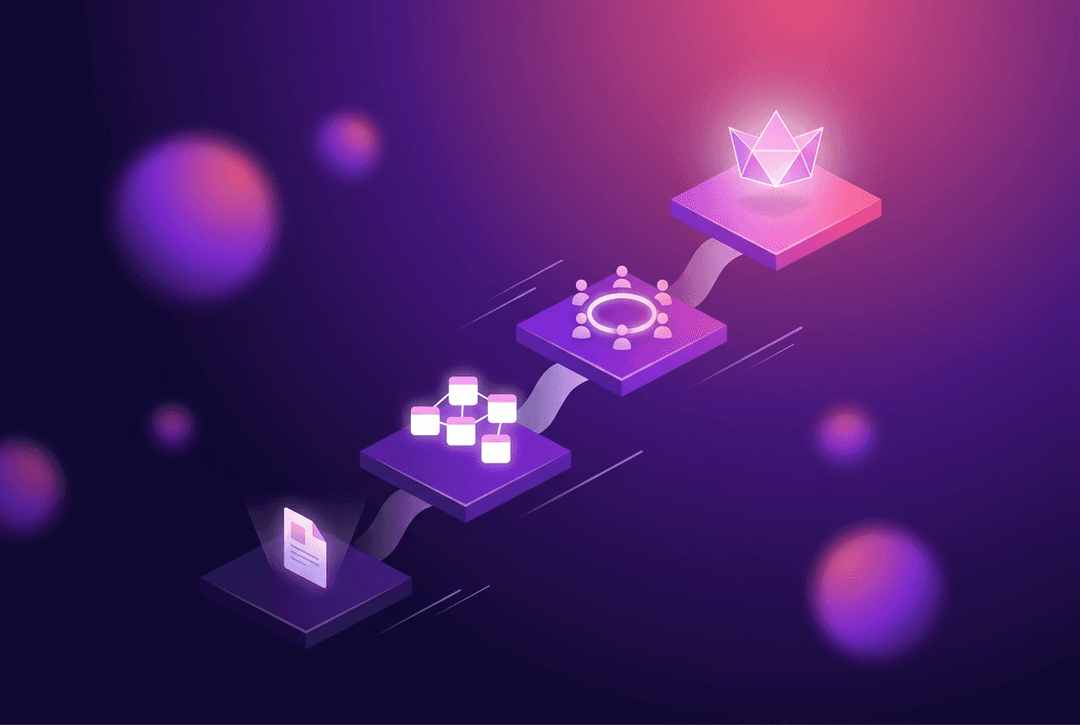
The funnel has three moves:
- Traffic → paid challenge ($49–$199). A 5–7 day sprint that delivers the first milestone of your program's promise. The fee matters: it filters for people willing to invest, and it funds your ads.
- Challenge → completion. This is the step most funnels don't have. Daily tasks, a cohort, a leaderboard, and a hard end date get people to the final day — and finishers are the only audience worth pitching.
- Final day → program invitation. A live close-out session (or final-day video) that celebrates results and presents the program as the continuation of what just worked.
Compare that with a webinar: one hour of passive watching versus a week of active doing. It's not a fair fight, which is why challenge launches have been steadily displacing webinars for coaches and course creators.
The math
Worked example with deliberately conservative numbers — a $2,000 program and a $99, 7-day challenge:
| Stage | Number |
|---|---|
| Challenge enrollments | 40 |
| Challenge revenue | $3,960 |
| Finishers (assume ~60%) | 24 |
| Enroll in program (assume ~1 in 8 finishers) | 3 |
| Program revenue | $6,000 |
| Total from one cohort | $9,960 |
Two things to notice. First, the challenge revenue alone covers meaningful ad spend — the front end can acquire customers at break-even or better, making the program enrollments close to pure margin. Second, every assumption is a lever: raise completion and the program revenue follows almost linearly. That's why the daily mechanics (tasks, streaks, cohort visibility) aren't engagement fluff — they're the profit engine.
Run the cohort quarterly and this single funnel is a ~$40k/year layer under your program — before any list growth compounds it.
Design the challenge to pre-sell the program
The most common failure is running a challenge that's adjacent to the program instead of upstream of it. Rules of thumb:
- The challenge outcome is step one of the program outcome. If the program promise is "launch your group coaching business," the challenge is "sign your first beta client in 7 days" — not "find your niche."
- Teach your actual method, smaller. Participants should finish thinking "if a week did this, imagine six months."
- Let the gap do the selling. Each day can honestly acknowledge what the challenge doesn't cover — that's the program's table of contents, delivered as generosity instead of a pitch.
- Name the next step early. Mentioning the program on day one ("this challenge is the first week of what I do in [program]") makes the final-day invitation expected rather than a bait-and-switch.
The final-day close
Keep it simple: a live session with three parts — results showcase (participants share wins, which is social proof happening in real time), the roadmap (here's what comes after this milestone), and the invitation with a genuine deadline (founding cohort price, bonus expiring, or enrollment closing). People who just finished something with you are at peak trust; the worst thing you can do is send them to a generic sales page a week later.
Mistakes that kill the funnel
- Free challenge, high-ticket pitch. The audience that shows up for free rarely has $2,000. Charge something.
- Too long. A 30-day challenge means your sales moment arrives after enthusiasm peaks — and after most people have dropped off.
- No live element. One kickoff and one close-out session double the feeling of a "real program" for minimal effort.
- Pitching non-finishers the same way. Send drop-offs a different sequence (rejoin next cohort) instead of the program pitch they're not warm enough for.
- Running it once. The first cohort is calibration. Completion and conversion numbers stabilize by cohort two or three — price accordingly and iterate.
Build the front end in an afternoon. Chalzy generates the full challenge — daily content, assignments, emails, images — from one description in under 10 minutes, handles paid enrollment via Stripe, and runs the cohort: daily unlocks, leaderboards, live sessions, and the analytics that show you completion and conversion per cohort. Start with a 2-minute quiz to find the right challenge type for your program.